
A client changes stylists, an independent esthetician moves to another location, or a salon replaces its booking system. Suddenly, the reception drawer contains appointment sheets, consultation cards and duplicate customer lists that nobody is sure they can discard. For New York salons and nonmedical spas, the difficult part of document shredding is often deciding who has authority over a record—not finding another box to put it in.
This guide addresses that handoff problem in ordinary hair, nail, waxing and esthetics businesses. It is not a medical-spa retention guide or a claim that every client card falls under a particular healthcare law. The approach is practical: identify the responsible business, separate active records from disposal candidates, resolve preservation questions, and release only approved paper for destruction. Whether your reception desk serves one owner or several independent practitioners, a short written workflow can prevent an end-of-month cleanup from becoming an accidental loss of working records.
1. Map the records behind the reception desk
Start with a walk-through rather than a blanket instruction to empty drawers. A salon may have a shared booking calendar, individual stylists’ formula cards, signed service acknowledgments, printed gift-card reports and separate employee files. These documents have different purposes. A list printed for today’s appointments is not automatically interchangeable with the underlying booking history or an original signed agreement.
The Federal Trade Commission’s guide to protecting personal information recommends taking stock of information, keeping only what is needed, protecting retained material and properly disposing of what is no longer needed. Apply that framework to the salon’s actual paper trail. Include material tucked under the checkout counter, carried between treatment rooms or printed temporarily during a software outage.
- Client-service records: consultation cards, service preferences, formulas and any relevant acknowledgments.
- Front-desk working copies: daily schedules, callback lists and handwritten booking notes.
- Business records: agreements, invoices, payroll material and practitioner rental paperwork.
- Transition copies: exported customer lists, migration checklists and duplicate reports.
For each group, note its location, responsible person and whether it is an original, working copy or duplicate. Do not put client names into the inventory when a category and date range will do. The inventory should help locate information without becoming another unnecessary customer list.
2. Agree who can authorize disposal in a shared salon
Shared space does not necessarily mean shared records. The New York Department of State’s appearance-enhancement business FAQ describes an area renter as a licensed operator working in an appearance-enhancement business who is not employed by the owner. That distinction makes a useful starting point for asking who controls paperwork. It does not, by itself, decide ownership of every client file.
Before combining boxes, have the owner and each relevant independent practitioner identify the records they are responsible for and the permissions governing access, transfer and disposal. Review applicable agreements; get legal advice when rights are disputed. A receptionist should not have to infer authorization from whose handwriting appears on a card or whose station was closest to the drawer.
A simple custody worksheet can record the document category, responsible business or practitioner, storage location, permitted users and disposal approver. Keep shared operational paperwork separate from a practitioner’s restricted files. Where a record supports more than one business, resolve the shared need before approving destruction rather than assuming the remaining copy belongs to someone else.
For example, when a stylist leaves, a departure checklist can distinguish salon invoices from that practitioner’s service cards and from jointly used appointment sheets. Any transfer should follow the parties’ actual rights and agreed process. Neither shredding nor copying everything is an appropriate shortcut around an unresolved custody question.
3. Separate retention decisions from the shredding schedule
A recurring collection date is not a retention policy. Establish a review process before deciding what goes into the disposal container. The FTC recommends a written policy identifying what information must be kept, how it is secured, how long it is retained and how it will be disposed of. There is no single keep-for-a-few-years rule in this guide for every salon document.
Ask the appropriate adviser about employment, tax, insurance, contractual and other requirements affecting each category. Also identify unresolved matters that require preservation, such as a customer complaint, insurer request, investigation or pending dispute. Do not destroy material relevant to a preservation obligation merely because its normal review date has arrived.
- Identify the category and the responsible record custodian.
- Check the approved retention instruction and any preservation restriction.
- Confirm whether an authoritative copy remains necessary and available.
- Record approval, or move uncertain material to a restricted review location.
Consider a duplicate consultation sheet found after a booking-system migration. Staff should verify whether information and signatures were captured accurately, whether the paper original must remain, and whether the digital record can actually be retrieved. Scanning alone is not permission to destroy the original. Marking uncertain folders “review required” is better than mixing them into a disposal batch and hoping somebody else has checked.
4. Control the path from the styling station to collection
Once disposal is approved, protect the paper until destruction takes place. A busy reception counter is a poor holding area: clients, cleaners, delivery personnel and other practitioners may pass through it. The FTC recommends locked storage and limiting access to people with a legitimate business need. Translate that advice into a location and access arrangement that work in your premises.
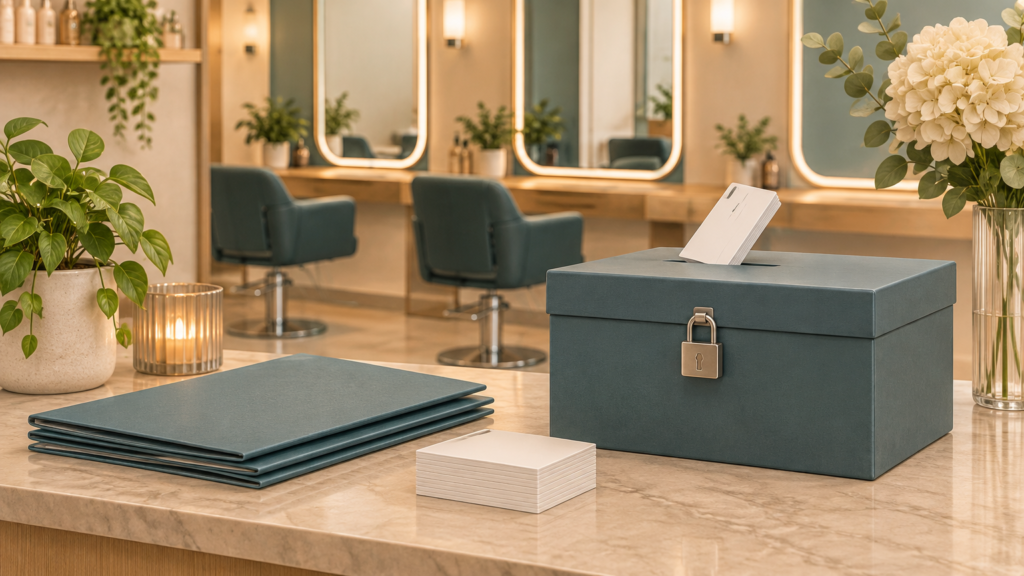
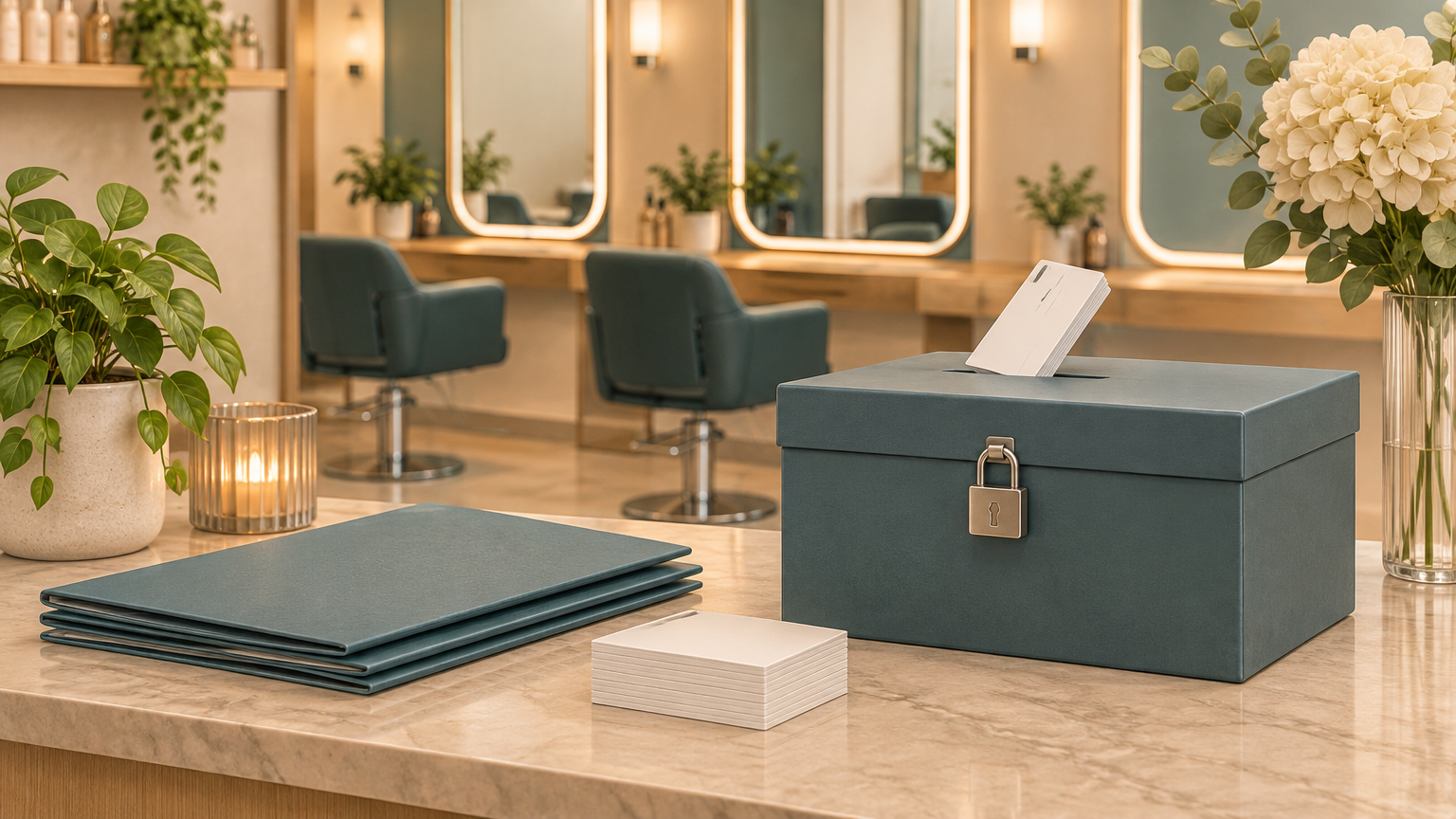
Use a dedicated closed, access-controlled container for approved paper, away from public waiting areas and wet workstations. Do not use a transparent bag beside ordinary recycling. Keep material awaiting a retention decision elsewhere; the disposal container should not double as an archive or a place to search for tomorrow’s appointment sheet.
Give front-desk staff a short rule: active papers return to their assigned storage, uncertain papers go to the named reviewer, and approved disposal papers follow the controlled collection route. At closing, check printers, consultation surfaces and the checkout area for abandoned working copies. This is a suggested operating routine, not a statement that a particular collection frequency is legally required.
Before arranging service, explain building access, stairs or elevator constraints, where approved boxes will wait, and who may release them. Review the provider’s published process information, then confirm the actual handling arrangements for your location. Ask how records are protected between collection and destruction rather than treating the word “secure” as a complete answer.
5. Treat practitioner departures and software changes as projects
One-off transitions deserve their own checklist. When an area renter leaves, a business changes hands or the salon closes, separate licensing administration from records administration. The Department of State FAQ describes licensing consequences of closure and ownership changes; it does not authorize a departing team to empty client files into recycling. Keep the records decision explicit.
Assign someone to list the affected paper categories, obtain custody decisions, arrange permitted transfers and identify what must remain accessible. Confirm receipt where records are transferred. Avoid putting client details on the outside of moving boxes; use a reference code and keep the matching inventory protected. Delay destruction for any category with unresolved access or preservation questions.
For booking-system changes, test retrieval before declaring the old records redundant. Can the responsible practitioner find a needed service history? Were attachment files and relevant notes transferred? Did a temporary export create new paper lists at reception? Resolve those questions before approving the transition copies for shredding.
Paper disposal also does not remove digital duplicates. Identify exports, shared folders and retired devices as separate tasks for the appropriate system administrator or specialist. Do not assume that emptying a paper drawer, deleting an icon or closing a software account completes the entire information lifecycle. The goal is a documented handoff, not a hurried clean counter.
6. Keep a useful disposal log and ask specific service questions
A disposal log should explain the decision without recreating the sensitive file. Record the category, approximate date range, approving person, release date and provider reference. Where several independent practitioners participate, keep approvals traceable to the appropriate custodian. Avoid listing client treatment details merely to prove that a box existed.
Before release, ask who takes custody, how material is held, what happens if access fails, and what completion documentation will be supplied. Confirm accepted materials rather than mixing paper with liquids, tools or electronics. If you need a particular certification or contractual safeguard, verify its current scope directly; a destruction document does not automatically establish that every legal or retention obligation has been satisfied.
When contacting New York Shredding Document Destruction, Inc., describe the approved paper volume, location constraints and whether separate practitioner batches need separate handling records. Review the paper shredding services information and ask which arrangements are available for your premises. This avoids relying on assumptions about service timing, equipment or program features.
For a nonmedical salon or spa, a useful shredding plan begins with clear custody and approval—not a medical-compliance slogan. Start with one drawer, assign a reviewer and resolve the uncertain categories before scaling up. When your approved paper is ready, contact New York Shredding to discuss the collection and destruction arrangements your business needs.